Theater of Grandeur

Edgaredit-small.jpg

November, 2018

Dear Friends,

“France cannot be France without grandeur” Charles De Gaulle declared. Throughout the ups and downs of French history since De Gaulle’s time, this theme is a constant. Never mind that critical theorists such as Michel Foucault were fiercely opposed to such profession of power. Never mind that there have been different notions of what that grandeur looks like, or that at least one President, François Hollande, did not see things this way. This view is in the French DNA. Emmanuel Macron, who has been called “Jupiter,” keeps a copy of De Gaulle’s Memoirson his working desk.

Charles De Gaulle was a Romantic. That is, his ideas were nurtured by the Romantic literary tradition. His favorite author was François-René de Chateaubriand (1768-1848), the founder of French Romanticism, who wrote a powerful defense of the Christian Faith based on beauty. In his Génie du Christianisme he attacked the Enlightenment for its rationalism and defended doctrine and sacraments for their emotional value. De Gaulle agreed, and believed France’s calling was to “light up the universe”.

In a marvelous new book about him Queen Mary University professor Julian Jackson writes about A Certain Idea of France (Allen Lane, 877 pages). It is likely the best biography of De Gaulle available in any language. Jackson touts the General’s extraordinary virtues and his courage. But he is also quite candid about his limitations. Toward the end he began to realize that the French were not up to this high calling. “France is worn out, she is made to be supine, not made to fight,” as De Gaulle explained to one aide. “I keep the theatre going as long as I can and then, after me, have no illusion, things will go back to where they were.”

A theatre! This is where the Bible is prescient about the mortality of the theater of grandeur: “Unless the Lord builds the house, those who build it labor in vain. Unless the Lord watches over the city, the watchman stays awake in vain.” (Psalm 127:1) Our Seminary, La Faculté Jean Calvin, in Aix-en-Provence, teaches that true splendor is found in nations and individuals who bow the knee to the Lord God, not in a Romantic idea of human grandeur. Oh that our beloved France would hear that call, not the call of De Gaulle, attractive as that may be, but the call to discipleship under the easy yoke of Jesus Christ.

Very Truly Yours,

William Edgar, President

Reformed Theology in France

OrteliusFrance.jpg

In 2011, Reformed Forum podcast hosts Camden Bucey, Jeff Waddington, and Jim Cassidy interviewed Yannick Imbert, Prof. of Apologetics & Church History, and Kim Tran, Directeur of the Faculté Jean Calvin seminary in Aix-en-Provence, France. Barbara Edgar provided translation.

Although now several years old, this audio interview remains very informative and relevant for those interested in the history and current state of Reformed theology in France.. The discussion spans the Reformation to philosophers such as Jacques Derrida and Michel Foucault. Click here.

Huguenot Fellowship Soirée

Rodrigo De Sousa, Prof of Hebrew & O.T., Faculté Jean Calvin

Rodrigo De Sousa, Prof of Hebrew & O.T., Faculté Jean Calvin

Image-2.jpeg

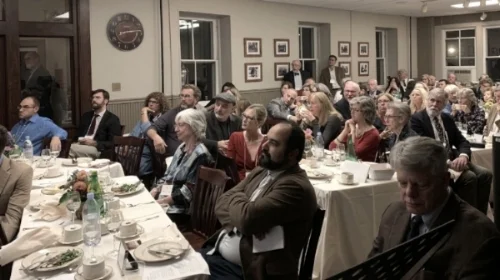
The Huguenot Fellowship (THF) recently held a Soirée at Westminster Theological Seminary near Philadelphia. This memorable evening included good food, great fellowship, engaging guest speakers, and special music. THF President Bill Edgar was master of ceremonies.

Prof. Rodrigo De Sousa came from Aix-en-Provence, France to share news of Faculté Jean Calvin (FJC), including his personal experience as a relatively new member of the teaching staff. We were reminded of FJC’s unique position in the French-speaking world as the Reformed and Evangelical seminary, which offers both undergraduate and graduate degree programs: training pastors, missionaries, and lay Christians to serve the Lord in the 250 million French-speaking world. FJC is truly blessed to have such talented and dedicated teachers as Dr De Sousa.

Dr Yannick Imbert, Prof of Apologetics & Church History, gave a talk on the history of FJC last summer at the seminary. A video was shown at the Soirée, and can be viewed by clicking on the link below, then click the play icon on the image. (Too large to download!)

History of FJC Video

Rev Paul Wolfe, Vice President of THF, delivered concluding remarks; thanking those who attended, and emphasizing the blessing and privilege it is to support THF with our prayers and gifts.

Please consider supporting The Huguenot Fellowship in its mission of spreading the Gospel of Jesus Christ through the work of the Faculté Jean Calvin. Thank you so much to you who faithfully do already!

Jesus in the City of Lights

Edgaredit-small.jpg

September, 2018

Dear Friends,

The City of Paris has long been the setting for romance and adventure. In her memoirs, The Only Street in Paris, master story-teller Elaine Sciolino recounts the marvels of the intricate, richly-human, colorful lives on a single street, La Rue des Martyrs, in the Pigalle Quarter. There she could purchase the best foods, buy the most specialized books, and witness the many public spectacles on the sidewalks. Each of its dwellers is a character, and each has a contribution to make. Paris is also the setting for the generation of world-changing trends and ideas.

Significantly the Rue des Martyrs is bookended by two historic churches, Notre Dame de Lorette and the Sacré-Cœur. Paris is populated by churches throughout the city. A many of them have stories going far back into the recesses of history. Sadly, not all of them have kept their original verve. Yet new initiatives are occurring on a regular basis. And they still connect with history, without being stuck in nostalgia.

Here is a marvelous story. A number of years ago Samuel Foucachon, a graduate of Faculté Jean Calvin in Aix-en-Provence, was working for a Jewish business man who knew he was a Christian and was deeply aware of Protestant history (there has always been a special connection between the Jewish community and French Huguenots who harbored them during the Nazi occupation). The man invited Samuel into his home and gave him a Bible from 1638. This Bible included a copy of the Gallican Confession, a rarity in that day. It had originally belonged to a Pastor Jacques Lafon, who signed the Confession. Today this Bible has come back to the Latin Quarter of Paris, where the Confession had originally been proclaimed. Samuel is the founding pastor of a church in the Chapelle de Nesle, two blocks from where the first Reformed synod met to ratify the Confession. Such an historical link gives credibility to the new church.

Samuel is not the only church-planter in Paris. Aix graduate Benoit Engel is working with Ed and Laura Nelsen, who have been involved in planting a church in the 17th arrondissement, where I grew up! The International Presbyterian church is planning to establish a community led by Westminster grad Gethin Jones. There are many more. As one person put it, “It’s the light of Jesus in the City of lights.”

Very Truly Yours,

William Edgar,
President

Rentrée 2018

L A F A C U L T É J EA N C A L V I N
invites you again this year to the heart of what matters.

Thank you for staying vigilant with us
in prayer, in testimony and in action,
defending the sovereignty of the Gospel of Jesus Christ
in everything we will experience together
during this new year!

Pray with us
for each new student
who will start their training course in Aix,
and for those who will finish it.

3339fe83-a212-494d-a5f6-cf08efcb0761.jpg

Between Karikal and Pondichéry

IMG_9014 copy.jpg

I spent my early childhood years in India, between Karikal and Pondichéry, former French trading posts. The cultural setting I grew up in was dominantly Muslim and Hindu, but at my private primary school I had a brief taste of Catholicism.

I came to live in France in 1964 when I was 5 years old. Three memorable landmarks stand out in my early life in France:
    - the joy of being able to attend Christmas mass
    - the childish joy of reading in a book, maybe a missal that the man who was said to be God said, "Let the children come to me and don't hinder them."
    - a hitch in my search for God when I was not allowed to follow catechism classes. My parents made it clear to me that I belonged to another religion which had its own gods, which even in certain way worshipped all gods!

For a long time I followed on in this syncretic religion which had such a disturbing mystical force, but I was also drawn to the all-powerful Christ. I was torn: how could I betray my parents by abandoning their faith? How could I follow Christ alone?

And so I went on in this ambiguous frame of mind until the age of 45. At the baptism of a long-standing friend I discovered something totally unknown to me until then: Protestant faith, with its strength firmly rooted in the Scriptures. I then found answers to my questions through some unexpected encounters. I also had two disturbing dreams and received a sign that left me scarred for life. And finally, in awe and fear of the Lord, I bowed the knee and confessed my faith in Christ. I pray God will allow me to continue to build on the rock which is Jesus Christ, to be ready to serve his church, and witness to his name by the power of the Holy Spirit.

Kali Kit, student